Synthetic slate roofing vs real slate in Pittsburgh
Synthetic slate roofing is made to look like stone at a fraction of the weight. If your old slate roof is truly finished, or you want the look on a house that never had slate, it is worth a close look. On a Pittsburgh roof where the stone is still sound, keeping real slate is usually the better deal. Here is how to tell which side of that line your roof is on.
Updated
What synthetic slate is
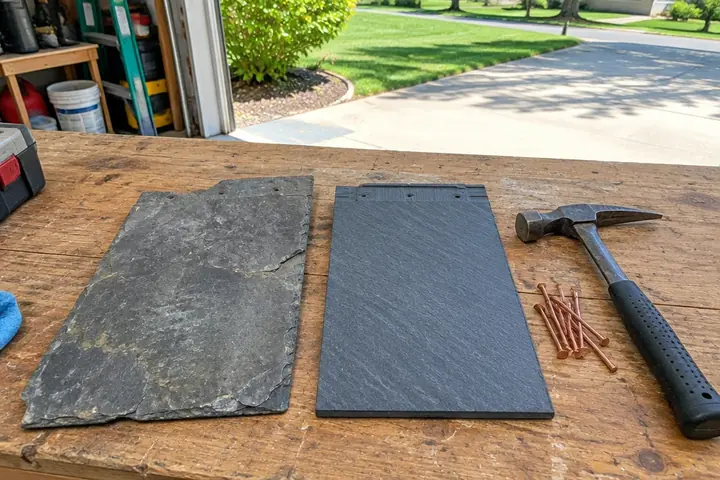
Synthetic slate, also sold as artificial slate roofing or an imitation slate roof, is a molded tile shaped and textured like split stone. Most of what is sold today is a polymer composite, made from plastics and rubber, often partly recycled, with color and UV protection mixed all the way through. Fiber cement slates are another kind: cement and fibers pressed into a slate shape, heavier and more brittle than polymer.
On older Pittsburgh houses you may also find mid-century mineral fiber slates, which often contain asbestos. They look like dull, very even slate. Have them tested before anyone cuts, breaks or removes them.
- Polymer or composite slate. Light and tough, and cut with ordinary roofing tools.
- Fiber cement slate. Heavier, and it can crack under foot like stone.
- Old mineral fiber slate. Common on mid-century homes, often with asbestos.
Why Pittsburgh's real slate roofs last
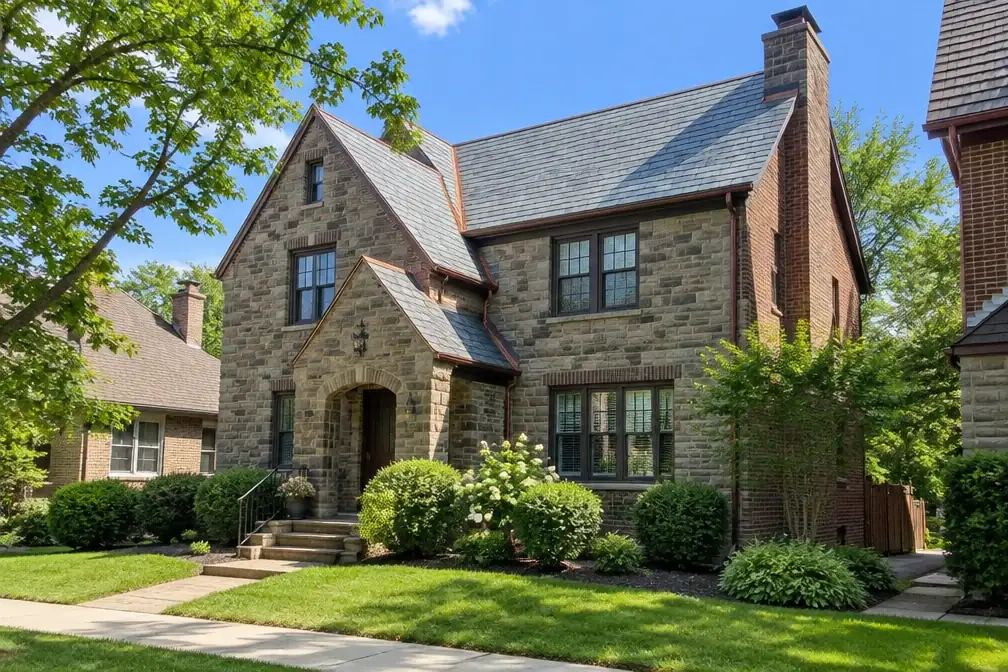
Pittsburgh's older neighborhoods were roofed when slate was at its peak. The National Park Service notes that the American slate industry reached its highest output between 1897 and 1914, with Pennsylvania the largest producer. Its guidance puts the life of a properly installed slate roof at 60 to 125 years or longer, depending on the stone: about 125 years for Vermont and New York slate, and more than 60 years for Pennsylvania soft-vein slate. An 80-year-old slate roof is not automatically finished.
What usually fails first is the metal: the nails, the flashing and the valleys. That is why our slate roofers start with a count of the bad slates before anyone talks about synthetic slate roofing or any other new roof.
Synthetic slate vs real slate, side by side
These are the differences that matter most on a Pittsburgh house. Product lines vary, so check the details of the one you are quoted.
| Real slate | Synthetic slate | |
|---|---|---|
| Lifespan | 60 to 125 years or more, by type of stone | Limited warranties of about 50 years are common |
| Weight | Heavy, and the framing has to carry it | A fraction of the weight of stone |
| Look | Natural color and texture, and some colors weather | Close from the street, more even up close, and can fade |
| Walking on it | Cracks under careless feet | Polymer types take foot traffic far better |
| Repairs | Single slates swapped by hand | Single tiles swapped, if the color is still made |
| Historic districts | The preferred material | Allowed in some districts where slate is not feasible |
Cost: closer than you might think
Synthetic slate tiles cost less than stone, but the tiles are only part of the bill. The National Park Service points out that tearing off the old roof, the flashing and the labor cost the same either way, so an artificial slate roof costs only a little less up front than a natural one. Over the long run, it says, natural slate tends to be the better investment, because several artificial roofs can come and go during the life of one natural slate roof.
Where synthetic slate wins is on houses that cannot carry the weight of stone, on additions and porches that need to match a slate main roof, and on homes that never had slate but suit the look. Ask for a written price on both, with the same tear-off, flashing and valley metal, so you compare like with like.
When synthetic slate makes sense
- The stone itself is soft and flaking across most slopes
- The house never had slate, and you want the look
- The framing cannot carry the weight of stone
- An addition or porch needs to match a slate main roof
- Your historic district review allows a look-alike where matching slate is not available
When to keep real slate
Most slate roofs we look at in Pittsburgh need repairs, not a new roof. Keep the stone if most of these are true.
- Most slates are still hard and ring when tapped
- The trouble is in the flashing, the valleys or the nails
- You plan to stay in the house for decades
- The house is in a historic district that wants slate kept
Historic districts in Pittsburgh
If your home is in a City of Pittsburgh historic district, a change of roofing material can need review. The city's December 2025 design guidelines for Schenley Farms in Oakland, for example, say existing slate should be kept and that architectural and three-tab shingles are not appropriate replacements, but they allow look-alike materials such as synthetic slate where matching slate isn't feasible.
Other districts have their own guidelines, and they change, so check the current rules for yours with the city before you plan a change. Repairing in the same material keeps things simplest.
How a synthetic slate roof goes on
A synthetic slate roof goes on more like a careful shingle job than like stone. The old roof comes off down to the deck, soft boards are replaced, and ice and water shield goes along the eaves and in the valleys, which matters in our freeze-thaw winters. Tiles are nailed through set points with each course offset, as on real slate, and the valleys and flashing should still be long-life metal such as copper.
Ask which product line is quoted, how the ridges and hips are finished, and whether the tiles come in a blend of shades. A blend looks far more like real slate than a single flat color, especially on a big Pittsburgh roof that you see from the street below.
Mixing real and synthetic slate
Patching a real slate roof with synthetic tiles rarely looks right, because the thickness, color and texture differ, and the two age differently. For repairs, salvaged or new natural slate is the better match. Synthetic slate works best on a whole roof, or on a separate section such as a porch or a rear addition where the change in material falls at a natural break.
Other options if the slate is finished
If the stone really is at the end of its life, you have three main choices: new natural slate, synthetic slate, or a heavy designer shingle cut to look like slate. Our guide to types of roof shingles covers designer shingles, and our metal roof vs shingles guide covers metal shingles stamped to look like slate.
Common questions
Is synthetic slate any good?
Good polymer synthetic slate is a solid roof: light, tough and close to the look of stone from the street. It doesn't last as long as good natural slate, so it fits best where the stone is finished or the house can't carry slate.
How long do synthetic slate roofs last?
Most makers sell them with limited warranties of about 50 years. Good natural slate lasts 60 to 125 years or more, according to the National Park Service.
What is synthetic slate roofing made of?
Most of it is a polymer composite of plastics and rubber, often partly recycled, with UV protection mixed in. Fiber cement slates are made of cement and fibers.
Can you walk on synthetic slate roof?
Polymer synthetic slate takes foot traffic far better than stone, though roofers still step with care. Fiber cement slate can crack, so treat it more like real slate.
What are fake slate roof tiles called?
Synthetic, composite, polymer, faux or artificial slate. Older mid-century versions are often called mineral fiber or asbestos-cement slates.
More roofing services
- repairs from our Pittsburgh roofers
- new roofs from our roofers
- help with roof leaks
- emergency roofers
- slate roofers in Pittsburgh
- rowhouse rubber roofs
- metal roofing in Pittsburgh
- small commercial roofs
- seamless gutters in Pittsburgh
- soffit and fascia work
- roof inspection in Pittsburgh
- ice dam removal
- roof ventilation
- box gutter relining
- copper roofing and gutters